Brussels and Belgium have an amazing public transportation network. In Brussels, if the metro doesn't take you there, then an easily accessible tram or bus surely will. What I find to be most impressive, and something DC should really look into, is that Brussels publishes a widely-available public transportation map that includes the Metro, Bus, and Tram lines so you do not have to spend time trying comparing Bus and Metro maps to figure out where you are going. The bus is not a mystery here, as it is to most casual public transportation users in D.C. It makes getting around town much more convenient, and the up to the minute GPS location of all public transportation vehicles is available online and over the phone (I hear D.C. might be trying to start this project up again). And on top of all that, a month long, unlimited public transportation pass, that is good on all forms of transportation is only 30 Euros for people under 26. As a carless District resident, I rely heavily on the metro and bus system to get to school and work and am grateful for the hard work of WMATA employees, but I really appreciate what the city of Brussels provides its residents and am looking forward to making some suggestions to WMATA when I get back.
Belgium is a small country; roughly the size of Maryland. Due to its size and wealth it has been able to build a rail network that zips you around the country in no time and with relative ease. Early on during the trip, I purchased a Go Pass for 50 Euros that provided me with ten one way trips anywhere in Belgium and have had a great time using it. With a Go Pass you don't need to stand in line at the station, you just fill out your destination on the ticket, hop on the train and go, no reservation required. Brussels to Antwerp in 45 minutes; Brussels to Gent in 35 minutes; Gent to Brugge in 25 minutes; anyway you get the idea. It’s easy to get around, making for endless possibilities for short day trips around the country so that you can make it back to Brussels at night and save on paying for hotels everywhere you go.
Belgium also has a great highway network for those places that don't have easy train access, and renting a car or finding a friend of a friend that has one is a great option for trips around Belgium. Gas is more expensive here than in the US, but you get the feeling you're actually paying what it’s worth. For those with travel ambitions a bit further afield, Brussels' main airport is easily accessible by public transport from multiple places in the city. Getting down to the Charleroi airport, where the budget airlines fly out of, is also relatively easy.
I know this may sound like an infomercial for public transportation in Belgium, but I am impressed and envious of the ease of travel here without having to own a car. As those who live in the DC area without a car know, it can be frustrating relying on infrequent, uncoordinated public transport without even the option of convenient travel to surrounding areas.
Tuesday, June 23, 2009

Monday, June 22, 2009
I never want to leave...
+Me,+Hilton+Roof,+cute!.JPG)
This has been a dream-come-true experience. Literally. My wildest dreams have all come true in Brussels. And honestly, I don't want to go back. I was pretty miserable in Washington. In fact, I'd been pretty depressed for a couple of years now. But I found my joy again in Brussels. I found my peace again in Brussels. I learned to laugh again in Brussels ... the laugh-until-you-cry laugh. God I had missed that!
+My+Host+Parents+Isabelle+and+Jeff.JPG)
Let me take a moment to express all my love and gratitude in the world to my 26 and 27-year-old "host parents," Isabelle and Jeff. They have been amazing "parents" to me! Even though I'm older than both of them, they have taken care of me in every way. Not only have they consistently cooked the greatest meals of my life for me, but Jeff has also been teaching me to cook! We've had great political and philosophical conversations, but they've also let me cry in front of them (I was so sad about leaving Brussels that I literally burst into tears in front of Jeff and Isabelle last week, but they assured me that I would be back, living in Europe, in no time, so there was no reason to be sad... they then handed me some chocolate to make me feel better ... and it worked). These guys are friends FOR LIFE!
+Me+and+Air+Bus.JPG)
Not only do I have the world's great "host parents," but I also have the world's great internship! Today, my boss Sharon said to me, "Leila, if I could, I'd hire you!" I love Sharon. She's the Managing Director of the State of Illinois - West Euopean Office of Trade and Investment. I've done so much at this internship! I've scheduled meetings with multinational organizations at the Paris Air Show. I've scheduled tours and briefings at the EU Commission and the Council of the EU for a visiting delegation from the University of Illinois (not to mention coordinating their hotels, restaurants, and 80-guest reception). Sharon has let me go to EU policy debates and panel discussions hosted by the European Policy Center and the German Marshall Fund. She invited me to the lauch of a new magazine called "WAB (Wallonia and Brussels) Magazine." While I was there I asked the editor if I could write for him, and he said yes! So I wrote an article about that night's launch party, and he wrote back to me today and said, "That was perfect. You set just the right tone. It'll be in this fall's issue." I'm going to be published in Europe!
+Me+in+Rockford+Booth.JPG)
Let me mention the Paris Air Show briefly. Yes, Sharon bought me a round-trip train ticket to Paris, a one-day pass to the Air Show, and tickets for the metro! I was there to man the "Rockford" booth. The city of Rockford, Illinois, had its own booth at the Paris Air Show to promote itself as a hub of aerospace technology and manufacturing. I also went to the booths of other aerospace companies and gave them information about "Quality Control Corporation," a precision manufacturing company from Illinois. So they definitely put me to work. But it was magical! While I was there I started talking to a gentleman from the UK. I told him that my dream was to live and work in the UK. He asked me what field I was in, and I told him that I was getting my Master's in International Media. He told me that he was a media consultant from the UK, gave me his card, and told me to email him my CV! What a day!
+Me+and+Eiffel+Tower.JPG)
When I left the Paris Air Show, I only had a couple of hours before my train left back to Brussels. But I did have time to take the metro to the Cathedral of Notre Dame. I walked around for about 30 minutes, and then I saw it -- the Eiffel Towel! This was my first time seeing the Eiffel Tower, in person, in my entire life! You know that scene in the second-to-last episode of "Sex and the City," when Carrie sees the Eiffel Tower out of her hotel window, and she clasps her hands and jumps up and down like a kid? Well, that was me. I was elated! I even got a stranger to take a picture of me with the Eiffel Tower in the background. It may be small, but it's there.
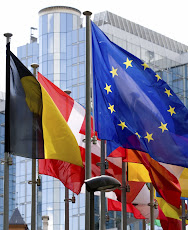
+Me,+EU+Flags,+farther-away.JPG)
Words cannot express how life-changing and life-affirming my time in Brussels has been. It brought me back to life. I was dead in D.C., but Europe brought me back to life. It reminded me of my passions and purpose. It reminded me that all of my wildest dreams can come true. I don't want to go back, I'm thoroughly dreading the plane ride back (what if I turn into anxiety-depression Leila again the moment I touch down in Dulles?), but my one saving grace is that I KNOW that I am living in Europe when I graduate next year. I absolutely did what I came here to do -- I healed, and I layed the foundation for my future life and my future career in Europe. I will be back.
Discovering Two Artists
Living in Brussels has allowed me to discover two artists: Emile Claus and René Magritte. I had been vaguely familiar with these two artists before, but didn’t know too much about their work, or that they were Belgian.

Museum of Fine Arts, Ghent
Impressionism is one of my favorite styles of art. Between Monet, Renoir and Degas, I had completely overlooked Emile Claus, the most prominent representative of impressionism in Belgium. This was until I visited a special exhibition of Claus’s work at the Museum of Fine Arts in Ghent. The exhibit, titled “Emile Claus and Rural Life,” provided an extensive showcase of Claus’s work throughout his life and showed the artist’s stylistic progression over time. It was very interesting to see how Claus began painting realistic subjects with impressionistic backgrounds, then moved to a more dedicated impressionistic style with less of an emphasis on human subjects and finally, the absence of all human subjects in Claus’s paintings completed towards the end of his life. The exhibit was very nicely done, and I am now a big fan of Emile Claus! Here are images of two of my favorite Claus paintings; the first painting is one of Claus’s most famous works, completed earlier in his life, and the second is part of a series Claus painted during World War I while being in exile in London:

The Picnic, 1887

The Thames in London, 1916
I have also discovered René Magritte, the most prominent Belgian surrealist artist. I have never really liked or fully understood surrealism, but after visiting the brand new Musée Magritte in Brussels, the museum dedicated to the artist, I now have a new appreciation for the movement. The Musée Magritte opened only about three weeks ago to great fanfare and has already taken its place as being at the forefront of knowledge about the artist. Magritte painted highly interesting paintings, challenging the viewer’s perception of reality. Sometimes, I found it impossible to discern the meanings of certain Magritte paintings and would have needed an explanation to better understand them. Here are images of two of my favorite Magritte paintings, both among his most famous works:

The Empire of Light, 1954

The Treachery of Images, 1928-1929
Discovering these two artists is just one of the many ways I continue to be pleasantly surprised by Belgium!
Wednesday, June 17, 2009
Ascension Mania


 So I'm going retro here a little with some pics from Brugge's Ascension Day procession on May 21, more specifically--Procession of the Holy Blood. This was a Catholic procession to rival all processions, an endless stream of costumed locals, with no shortage of sheep herds, horses (of unusual size), dogs, camels, leather sandals and orange spray tans. And of course the procession-ee of honor, the Holy Blood itself, said to be brought back trimphantly from the Crusades by the Count of Flanders in 1150.
I was sniffling from a leftover virus through the event, menacing horses and all, but it was completely worth it to experience this local gem court-side.
Sunday, June 14, 2009
Brussels in Pictures
Some pics I took around the city...

View from the Top

Palais du Justice

Random Prettiness

Waffles!

Cafe Culture
Business and Bisous
In keeping with the recent string of posts about internships, I’ll take some time to blog a bit about my own work experience in Brussels.
I’m interning at Liberty TV a French- and Dutch-language television station that broadcasts travel shows. Of the five organizations at which I had interviewed, this one had been my top choice, because I wanted to learn more about television production and because I wanted to be able to practice my French in a professional setting. I was ecstatic when I found out I had the job, but, I have to admit, once I got to the office on the first day and became submerged not only in a foreign work environment, but also in a foreign language, I began to wonder if I had gotten in over my head.
After the first couple of days however, I not only started to get used to this new setting, but I also started to have a lot of fun! My job entails assisting the television production team, a small group that consists of two anchors, a producer, and two video editors. My tasks generally include finding and writing up short, travel-related news reports for the anchors’ morning news segment, researching travel information about various countries around the world for a set of mini Web guides the team is producing, and helping to come up with a new design and content for the organization’s Web site. I’ve also written interview questions for guests, edited show segments using Final Cut Pro, assisted with filming by working the teleprompter, and participated in a screening during which the team watched and rated potential documentaries for the channel.
Over the past month, I’ve learned a great deal about television production. I’ve also had the opportunity to learn about a Belgian workplace. In a lot of ways, it reminds me of an American workplace. One thing that is different though, at least in my experience, is lunchtime. Generally the whole team will get together to eat and chat. Furthermore, unlike in the places where I have worked or interned at in the States, people take their whole allotted hour for their meal, instead of rushing back to their desks once they’re done with their food. Another workplace custom that is new to me is the way in which people greet one another. In Brussels people kiss each other once on each cheek when they say hello, even in a professional environment. These kisses are called 'bisous'. I’m not used greeting friends in this manner, much less co-workers, and I haven’t quite adjusted to this one yet, but I’m getting there!
So, all in all, my internship with Liberty TV has been wonderful. At times it has been frustrating to be working in a foreign languge, but I've learned a great deal from these challenges. Certainly, I'll never forget this experience, and I know the skills I have gained here will help me for years to come.
Thursday, June 11, 2009
Interning at the EJC
I was very excited when I heard that I would have the opportunity of interning at the European Journalism Centre (EJC)! The EJC was not originally listed in the Brussels program application as a possible place to intern with, and I remember listing it as one of the top organizations I would be interested in for an internship. I have even used the EJC’s work in the past when conducting research for multiple papers!
The EJC is primarily involved in organizing and executing seminars for journalists and Brussels correspondents for media outlets across Europe, but also for journalists from the countries of the European Neighbourhood Policy (ENP) and beyond, such as Turkey, the Balkan countries, Brazil and Canada. The primary goal of the seminars is to expose these journalists to the European Union and provide them with information about the structure and mission of EU institutions, so that the journalists are able to report more accurately about the EU. In addition, the EJC monitors and researches the media landscape across Europe and provides a tremendous amount of news and resources to journalists and members of the media across Europe and around the world.
Subscribe to:
Posts (Atom)

 Posts

